Fused Quartz is a demanding material, not simply clear glass. Its low thermal expansion and resistance to high temperatures make it important in semiconductor processing, optical systems, and laboratory equipment. Yet a supplier’s headline specifications do not tell the whole story. Purity, bubbles, inclusions, surface finish, and dimensional tolerances can vary between grades and production batches.
Demand context matters. SEMI’s December 2024 semiconductor equipment forecast projected global sales of $113 billion in 2025, rising to $139 billion in 2026. These figures are not a measure of fused quartz demand. They do, however, reflect substantial investment in manufacturing equipment that uses specialized quartz components. The USGS Mineral Commodity Summaries 2025 also tracks industrial sand and gravel production, a broad silica category. It should not be mistaken for data on high-purity fused quartz. That distinction is easy to miss.
This guide compares ten manufacturers for global buyers, focusing on product range, technical documentation, quality controls, customization, and export support. Look for traceable material certifications, clear inspection criteria, and realistic lead-time commitments. Ask whether published tolerances apply to finished parts or raw stock. Small detail. It can change a purchase decision. Public information is uneven, and supplier claims may not be directly comparable. Treat this list as a practical starting point, then verify critical specifications with the manufacturer before ordering.
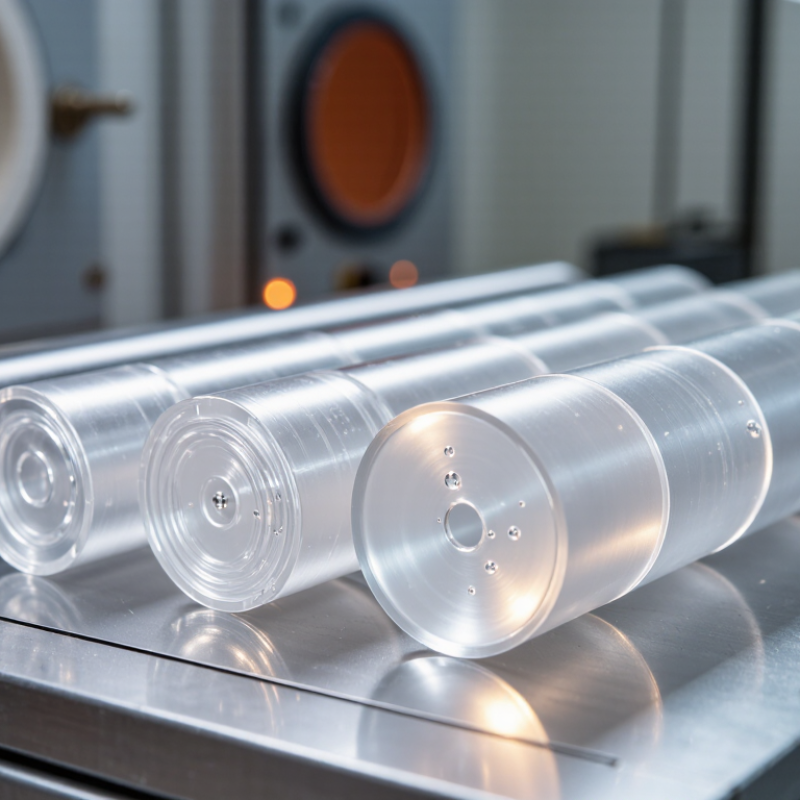
Fused quartz is amorphous silicon dioxide, SiO₂. Its atoms lack the repeating crystal lattice found in crystalline quartz. It is not simply clear quartz: melting and cooling remove long-range order. This difference affects optical transmission, thermal expansion, and performance during rapid temperature changes. Small detail, big consequence.
“Fused quartz” often describes material melted from natural quartz, while “fused silica” may refer to synthetic silica; usage varies among suppliers. Check the specification, not just the label. The USGS Mineral Commodity Summaries 2025 estimates U.S. industrial sand and gravel production at 120 million metric tons in 2024. That broad figure covers many uses, not fused-quartz feedstock specifically. A bulk silica statistic cannot verify a component’s grade. Buyers should compare trace-metal limits, hydroxyl content, bubbles, and batch consistency alongside SiO₂ purity. A 99.99% figure sounds decisive, but it can hide important differences in optical or thermal performance. That caveat is easy to miss.
For global buyers, fused quartz stands out for its low thermal expansion, typically around 0.5 × 10⁻⁶/K. A component can face sharp temperature changes with less dimensional movement than many common glasses. That matters in furnace viewports, laboratory tubes, and precision fixtures. Small movement can still affect alignment. The exact value depends on material grade, temperature range, and test method, so request data for the intended application.
The softening point is approximately 1,665°C, but that does not mean every part can operate continuously at that temperature. Load, exposure time, surface condition, and thermal gradients all influence performance. A thin tube and a thick support may respond differently. Buyers should review temperature limits alongside dimensions, tolerances, and thermal-cycle requirements. Specifications deserve a second look; they are easy to misread.
Tips: Ask for a current technical datasheet and clarify how CTE and softening point were measured. Check sample parts under realistic heating and cooling conditions. A quick bench test may help, though it cannot replace qualified engineering review.
Flame-fused and electrically fused quartz differ in how silica is melted, and that difference can affect hydroxyl content, bubbles, and consistency. In flame fusion, a hydrogen–oxygen flame melts silica powder; water formed during combustion can raise hydroxyl levels. Electric fusion melts silica in a heated furnace and often produces lower-OH material, though results depend on furnace design and process control. Small details matter.
For optics or hot-zone parts, compare measured hydroxyl content, bubble and inclusion limits, and lot-to-lot variation—not just the process label. Higher hydroxyl content can increase infrared absorption, while bubbles may scatter light or weaken a component. Ask for test data tied to the actual grade and intended wavelength or temperature. I would not treat either method as automatically superior; the application decides. The USGS Mineral Commodity Summaries 2024 estimated U.S. industrial sand and gravel output at about 120 million tons in 2023. That figure covers a broad raw-material category, not fused-quartz feedstock specifically, but it illustrates why buyers should verify silica purity and traceability rather than infer them from supply volumes. A practical check: request a recent certificate showing the properties that matter to your design.
A method-focused comparison of ten technical and procurement factors. The rows compare manufacturing characteristics, not named or ranked companies.
| No. | Comparison Factor | Flame-Fused Grades | Electrically Fused Grades | What Global Buyers Should Verify |
|---|---|---|---|---|
| 1 | Basic manufacturing method | Silica feed is melted and consolidated using a high-temperature flame, commonly an oxyhydrogen flame. | Silica is melted using electrical heating; furnace design and atmosphere vary by producer and product. | Request a process description and confirm that the quoted grade matches the required application. |
| 2 | Hydroxyl (OH) content | Flame processing can introduce hydroxyl from water vapor in the combustion environment; actual content depends on process control and grade. | Can be produced with relatively low OH content, but the result depends on furnace conditions, feedstock, and finishing. | Ask for the specified OH limit and a lot-specific test result, such as infrared measurement where applicable. |
| 3 | Metallic impurity control | Purity depends on silica feedstock, handling, equipment, and contamination controls throughout processing. | Purity also depends on feedstock and process controls; furnace or contact-material contamination must be managed. | Compare impurity limits and analytical methods on the certificate of analysis (COA), not just general “high-purity” claims. |
| 4 | Bubbles and inclusions | Bubble population varies with feedstock preparation, melting, consolidation, and the selected quality grade. | Bubble population varies with furnace design, refining conditions, and grade requirements. | Specify allowable bubble size, quantity, and inspection method for the intended optical or industrial use. |
| 5 | Homogeneity and striae | Optical homogeneity depends on process consistency and grade; the method alone does not guarantee a striae-free product. | Homogeneity depends on melting and refining control; electrically fused material is not automatically optically homogeneous. | For optical components, request transmission, homogeneity, and striae data against a stated test standard or specification. |
| 6 | Available forms and dimensions | Availability may include shaped blanks or other forms, depending on the producer’s equipment and product range. | Availability may include bulk or formed products, depending on furnace capacity and downstream processing. | Confirm maximum dimensions, tolerances, and whether the quotation is for an as-fused or machined part. |
| 7 | Thermal properties | Fused silica generally has low thermal expansion; the exact value depends on composition and measurement conditions. | Fused silica generally has low thermal expansion as well; manufacturing method alone does not establish the product’s value. | Request the grade’s measured or specified thermal-expansion data and operating-temperature guidance. |
| 8 | Optical transmission | Transmission depends on wavelength, OH content, impurities, thickness, and surface finish. | Transmission likewise depends on wavelength, OH content, impurities, thickness, and surface finish. | Compare spectral-transmission curves over the actual wavelength range, with sample thickness and test conditions stated. |
| 9 | Machining and finishing | Machinability and finishing quality depend on the grade, shape, and supplier’s secondary-processing capabilities. | Machinability and finishing quality also depend on the grade, shape, and secondary processing—not solely on the melting method. | Clarify edge condition, surface finish, dimensional tolerances, cleaning, and packaging requirements in the purchase specification. |
| 10 | Documentation and lot traceability | Documentation is supplier- and order-specific; flame-fused products should be traceable to the supplied lot. | Documentation is supplier- and order-specific; electrically fused products should be traceable to the supplied lot. | Require a COA, lot identification, agreed inspection records, and export or origin documents where needed. |
Buying note: Flame-fused and electrically fused are process descriptions, not universal performance grades. Properties vary with feedstock, manufacturing controls, finishing, and the supplier’s specification; confirm critical values with lot-specific documentation.
The fused quartz supplier landscape varies by region, production scale, and intended use. East Asian manufacturers often serve buyers seeking broad product ranges and higher-volume production. European suppliers may focus on tighter process control, specialty shapes, or demanding optical and laboratory applications. North American producers are often evaluated for technical support, documentation, and custom fabrication. These are general patterns, not guarantees; capabilities differ from plant to plant.
Grade selection should match the working environment. High-purity material can matter where trace contamination affects process results, while optical grades require careful attention to transmission, bubbles, and striae. Thermal applications call for consistent dimensions and resistance to rapid temperature changes. Ask for current specifications, inspection records, and sample parts. Small details matter. A polished datasheet alone cannot show how a tube behaves after repeated heating.
Compare manufacturers by specialty, not by a single global ranking. Some excel at tubing and rods; others handle crucibles, windows, or custom components. Confirm tolerances, lead times, packaging, and the method used to verify purity. That sounds tidy, but reality is messier: quoted grades may not be directly comparable across suppliers. Requesting the same drawing and test criteria from several candidates makes evaluation fairer. One overlooked detail can become an expensive delay.
For the 10 best fused quartz manufacturers, compare documented capability—not just quoted price. Request a lot-specific certificate of analysis showing silica purity and trace-element limits. Ask how hydroxyl content, bubbles, and inclusions are measured; “high purity” alone is not a usable specification. Check dimensions against a controlled drawing, including thickness, flatness, and tolerance. Small errors matter.
The USGS Mineral Commodity Summaries 2025 estimates U.S. industrial sand and gravel output at about 120 million metric tons in 2024. That broad category is not a measure of high-purity fused quartz availability, but it highlights why buyers should verify the actual feedstock and process behind a supplier’s claims. Request sample inspection records and traceability linking each part to its production lot. Confirm that quality certificates are current and cover the manufacturing site supplying your order.
Lead times deserve the same scrutiny. Ask for separate estimates for standard stock, custom forming, finishing, and final inspection. Get the quoted schedule in writing, including shipment date and how delays are reported. A polished sample can hide a weak production process. I would also ask how dimensional results are recorded; many buyers overlook measurement methods until parts fail incoming inspection.
Reference temperatures for fused silica—not supplier-specific ratings. Verify the exact material grade and test method with each manufacturer.
When comparing suppliers, request documented purity and dimensional tolerances, applicable certifications, and a confirmed lead time for your exact specification. These vary by grade, product form, and order.
Its coefficient of thermal expansion is around 0.5 × 10⁻⁶/K. This can limit dimensional movement during sharp temperature changes. Small shifts still matter. The exact value depends on grade, temperature range, and test method.
No. Load, exposure time, surface condition, and thermal gradients affect performance. A thin tube may respond differently from a thick support. Check the part’s operating limits.
Request a lot-specific certificate of analysis with silica purity and trace-element limits. Ask how hydroxyl content, bubbles, and inclusions are measured. “High purity” alone is too vague.
Compare the part with a controlled drawing. Include thickness, flatness, and dimensional tolerances. Ask how measurements are recorded. Small errors matter.
Request sample inspection records and traceability linking each part to its production lot. Confirm that certificates cover the manufacturing site supplying your order. Ask for current documents.
Request separate estimates for stock, custom forming, finishing, and final inspection. Confirm the shipment date and how delays will be reported. Get the schedule in writing.
Test them under realistic heating and cooling conditions. A bench test can help, but it cannot replace qualified engineering review. I might be overlooking one detail: your actual load matters.
No. The cited U.S. output estimate covers industrial sand and gravel, not high-purity fused quartz availability. Verify the feedstock and process behind a supplier’s claims.
Fused Quartz is an amorphous form of silicon dioxide (SiO₂), distinct from crystalline quartz in structure and performance. Its very low thermal expansion—approximately 0.5 × 10⁻⁶/K—and softening point near 1,665°C make it useful in demanding thermal and precision applications. Manufacturers generally produce fused quartz through flame-fusion or electric-fusion processes; each method can yield grades with different characteristics, so buyers should match the production route and material specification to their intended use.
The global supplier landscape includes manufacturers serving different regions and specializing in products such as tubing, rods, plates, and custom components. When comparing potential suppliers, buyers should look beyond price and confirm material purity, dimensional tolerances, relevant certifications, production capabilities, and realistic lead times. A clear understanding of grade and manufacturing method, combined with careful verification of supplier documentation, can help buyers select consistent materials and reduce sourcing uncertainty.