Choosing a Quartz Glass supplier is not a catalog exercise. Buyers need to know how each company controls purity, dimensions, and consistency across production batches. A clear tube may look flawless under showroom lights, yet small variations in wall thickness can affect its performance in a heated assembly. The right comparison goes beyond price.
This guide reviews ten suppliers for global buyers, focusing on practical evidence: product range, manufacturing capabilities, quality documentation, customization, and responsiveness. Ask for specifications that match your application, sample parts where appropriate, and clear explanations of inspection methods. A polished datasheet helps. Traceable quality records help more. No single supplier is best for every project; the right choice depends on operating conditions, order volume, and support needs.
A useful sourcing principle is simple: “Verify the process, not just the promise.” I cannot responsibly attribute that sentence to a named Quartz Glass expert without a verifiable source. That matters in a supplier guide built around trust. Use the ten profiles as a shortlist, then confirm current capabilities directly with each manufacturer. Check lead times, packaging, export experience, and how the supplier handles specification changes. Small details count. A loose tolerance can become a costly surprise. The comparison ahead aims to make those questions easier to ask—and harder to overlook.
Quartz Glass: Properties, Types, and Industrial Uses
Quartz glass is made from high-purity silica and retains useful optical and thermal properties at temperatures that challenge ordinary glass. It expands very little when heated, resists thermal shock, and transmits ultraviolet light better than common soda-lime glass. It is not indestructible. Surface contamination, bubbles, and machining flaws can still weaken a finished component.
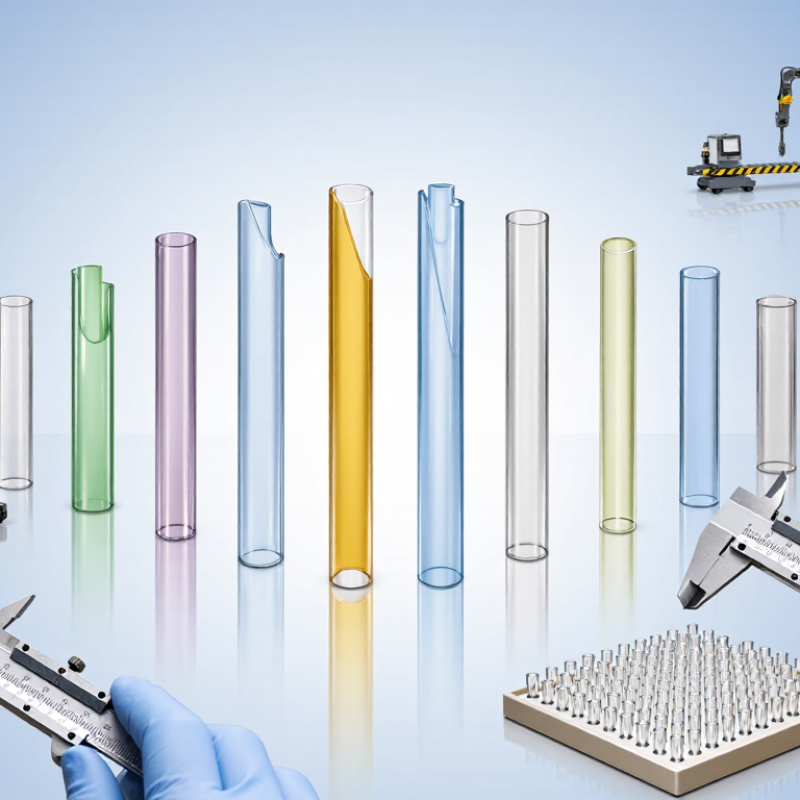
Common types include transparent fused quartz, opaque quartz glass, and synthetic fused silica. Transparent grades suit inspection windows, lamps, and laboratory vessels; opaque grades are used where heat resistance matters more than light transmission. Synthetic material can offer tighter control over trace impurities, an important consideration for optical and semiconductor processes. Details matter: a supplier’s purity, hydroxyl content, and dimensional tolerances should match the actual operating conditions.
Demand signals are useful, but they do not measure quartz-glass demand directly. The World Semiconductor Trade Statistics Autumn 2024 forecast reported global semiconductor sales of $627.6 billion in 2024, up 19.1% year over year. That growth supports investment in equipment where quartz parts may be used, though it does not prove equal growth in quartz components. The USGS Mineral Commodity Summaries 2025 estimated U.S. industrial sand and gravel production at 120 million metric tons in 2024; this broad category is not a measure of high-purity quartz feedstock. A gap remains. Buyers should request application-specific test data, not rely on a general “high purity” claim alone.
Top 10 Quartz Glass Suppliers for Global Buyers - Quartz Glass: Properties, Types, and Industrial Uses
Supplier-neutral buying guide: the entries below describe common quartz glass product types and forms, not ranked companies. Properties vary by grade, manufacturing process, dimensions, and test method; confirm specifications with the supplier.
| No. | Quartz Glass Type or Form | Typical Properties | Common Industrial Uses | What Buyers Should Verify |
|---|---|---|---|---|
| 1 | UV-grade synthetic fused silica | High optical transmission into the ultraviolet range in suitable grades; low thermal expansion and carefully controlled optical defects. | UV optics, photolithography components, excimer-laser systems, and analytical instruments. | Transmission range at the required wavelength, thickness, surface quality, homogeneity, and applicable inspection standard. |
| 2 | Optical-grade natural fused quartz | Transparent silica glass with low thermal expansion; optical transmission and impurity levels depend on grade and production method. | Optical windows, lamp envelopes, instrument components, and laboratory equipment. | Optical grade, transmission curve, bubbles and inclusions, surface finish, and dimensional tolerances. |
| 3 | General-purpose transparent fused quartz | Excellent thermal-shock resistance and very low thermal expansion compared with ordinary glass; withstands high-temperature service subject to design and conditions. | Laboratory ware, sight glasses, furnace components, and high-temperature process equipment. | Maximum recommended operating conditions, thermal cycling requirements, wall thickness, and chemical compatibility. |
| 4 | Opaque quartz glass | Contains distributed bubbles or other light-scattering features that reduce light transmission; retains useful thermal properties of fused silica. | Furnace tubes, heaters, thermal-processing equipment, and applications where optical transparency is unnecessary. | Opacity consistency, permissible bubble structure, dimensions, thermal limits, and contamination requirements. |
| 5 | High-purity quartz tubing | Available in transparent or opaque forms; fused-silica tubing offers low thermal expansion and high-temperature capability. | Semiconductor and laboratory furnaces, chemical processing, protective sheaths, and fluid-handling systems. | Outer and inner diameter, wall thickness, straightness, end finish, purity, and dimensional tolerances. |
| 6 | Quartz plates and windows | Flat fused-silica components can provide optical transmission and thermal stability; performance depends on material grade and finishing. | Viewing ports, optical instruments, vacuum systems, and high-temperature inspection windows. | Flatness, parallelism, surface quality, edge finish, coating needs, wavelength range, and pressure or temperature conditions. |
| 7 | Quartz rods and bars | Solid fused-silica forms with low thermal expansion and good resistance to many high-temperature environments. | Supports, spacers, stirrers, furnace fixtures, and custom-fabricated components. | Diameter or cross-section, length, straightness, surface finish, purity, and machining requirements. |
| 8 | Fused-silica crucibles | Designed for high-temperature use; performance depends on purity, dimensions, surface condition, and the process environment. | Silicon crystal growth and other high-temperature melting or processing applications. | Process compatibility, purity, capacity, wall thickness, geometry, and traceability of material batches. |
| 9 | Quartz boats and wafer carriers | Heat-resistant components commonly made for repeated use in controlled thermal processes; cleanliness and fabrication quality are critical. | Wafer handling in semiconductor diffusion, oxidation, and other furnace processes. | Wafer size and loading arrangement, slot dimensions, cleanliness, surface condition, and thermal-cycle requirements. |
| 10 | Quartz capillaries and small-bore tubing | Small-diameter fused-silica forms can offer chemical resistance and high-temperature performance; precise dimensions are application-dependent. | Analytical instruments, laboratory fluid paths, sample handling, and specialized process equipment. | Inner and outer diameter, concentricity, length, end finish, cleanliness, and chemical compatibility with the sample. |
FAQS
It is used in semiconductor processing, optics, and scientific equipment. Needs vary by application.
Check impurity limits, hydroxyl content, bubble counts, optical transmission, and thermal performance. Match each measure to the intended use.
No. Semiconductor equipment sales and bulk silica output do not directly measure demand for high-purity quartz glass.
Ask for recent test certificates, measurement methods, traceability records, and inspection results. A polished datasheet is not proof.
Qualify a sample or small production batch. Compare its dimensions and test results with the supplier’s stated tolerances. Small tests help.
Confirm packaging, shipping arrangements, lead times, sample handling, and production capacity. A delayed shipment can disrupt plans.
Some focus on tubes, rods, and plates; others offer custom fabrication, laboratory ware, optical parts, or technical support.
No. Audits take time and may miss process variation. Independent testing can add useful evidence, though it is not perfect.
A second qualified source can reduce reliance on one shipment. I may be overvaluing that backup; qualification also takes time.
Conclusion
This article introduces Quartz Glass by explaining its key properties, common types, and uses across industries that require heat resistance, chemical stability, or optical clarity. It also outlines how global buyers can assess potential suppliers, including their product range, manufacturing capabilities, quality-control processes, certifications, communication, and ability to support international orders.
A practical overview of the global market highlights factors that shape supplier selection, such as technical fit, consistency, pricing, shipping arrangements, and lead times. Profiles of ten suppliers serving international buyers provide a framework for comparing their capabilities without relying on a single criterion. The final comparison helps readers consider quality standards, production capacity, customization options, and delivery schedules together, enabling a more informed sourcing decision based on project requirements and long-term reliability.