Specialized Fused Quartz Disc & Optical Components Portfolio
Engineered to withstand temperatures up to 1400°C with severe thermal shock resistance, verified under polarization stress analyzers for Finnish optical engineers and industrial machine manufacturers.

Technical Differentiation: Fused Quartz vs. Synthetic Fused Silica Discs
A rigorous specification guide for procurement engineers, research scientists, and system integrators operating in the Pirkanmaa economic region.
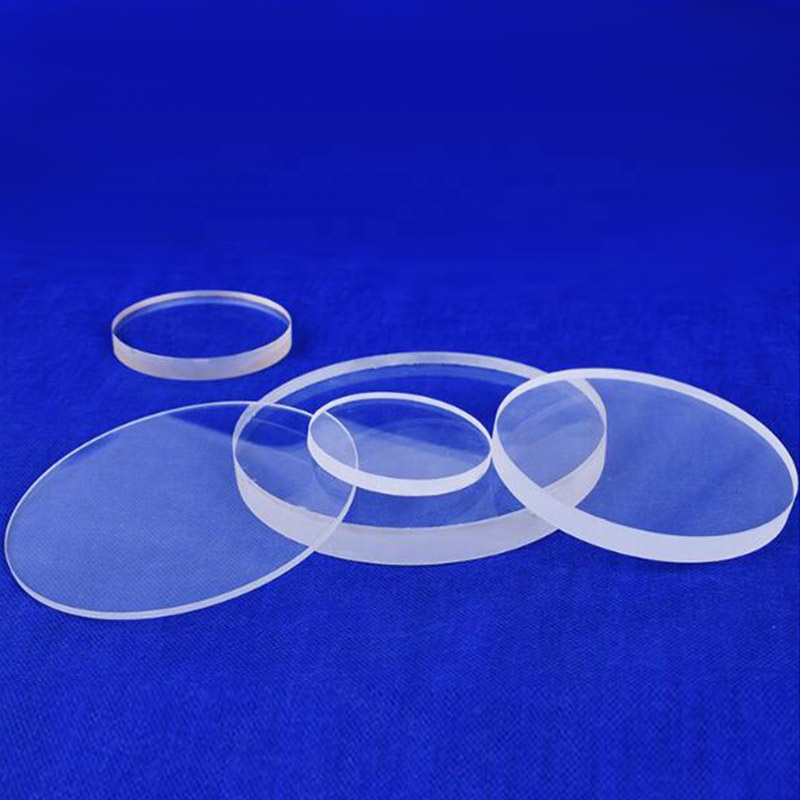
When procuring quartz glass discs for demanding industrial or academic projects in Tampere, choosing between synthetic fused silica and naturally fused quartz is the single most critical engineering decision. While standard borosilicate or soda-lime glass fractures under rapid temperature fluctuations and exhibits significant absorption bands in the ultraviolet (UV) and near-infrared (NIR) spectrums, fused quartz discs possess an exceptionally low coefficient of thermal expansion (CTE ≈ 5.5 × 10⁻⁷ /°C). This characteristic makes them fundamentally immune to thermal shock up to a continuous 1100°C, withstanding sudden water-quenching cycles from 1000°C without catastrophic structural failure.
| Optical Grade | Primary Material Base | Transmission Window | Hydroxyl (OH⁻) Content | Dominant Finnish Industrial Use Case |
|---|---|---|---|---|
| JGS1 (Synthetic Silica) | SiCl₄ Chemical Vapor Synthesis | 185 nm – 2,500 nm (Deep UV) | < 1 ppm to 1200 ppm (Grade Opt) | Laser lithography, excimer laser optics, Tampere photonics lab sensors. |
| JGS2 (Optical Fused Quartz) | Refined Natural Quartz Crystal (Flame) | 220 nm – 2,500 nm (UV / VIS) | ≈ 30 ppm – 150 ppm | Spectrophotometer discs, industrial sight windows, UV curing lamps. |
| JGS3 (Infrared Fused Silica) | Electrically Melted Natural Quartz | 260 nm – 3,500 nm (Full NIR) | < 5 ppm (Water-free) | Thermal imaging viewports, IR pyrolysis, industrial heat sensors. |
| Opaque Quartz Glass | Micro-bubble Enriched Sintered Silica | Diffuse Reflection / IR Barrier | Variable | Flange insulation, furnace hearth discs, semiconductor heat shielding. |
Localized Application Scenarios in Tampere's High-Tech Ecosystem
Precision-matched optical disc solutions powering the intersection of photonics, industrial machinery, and health technology in Southern Finland.
Photonics & Laser Material Processing
Tampere hosts one of Europe's most concentrated optics ecosystems, driven by academic research at Tampere University (TAU) and spin-off companies developing ultrafast picosecond and femtosecond fiber lasers. Our double-side polished JGS1 quartz discs function as essential protective debris shields, beam splitters, and output coupler windows. The high Laser Induced Damage Threshold (LIDT > 10 J/cm² at 1064 nm, 10 ns) prevents micro-pitting and beam profile distortion during high-energy steel and polymer ablation processes across industrial manufacturing cells in Pirkanmaa.
Medical Technology & Biosensors
With Kauppi Health Park standing as an epicenter for Finnish medical technology, specialized diagnostics demand optical windows that eliminate background autofluorescence. Our JGS1 fused silica discs feature near-zero UV-excited fluorescence, making them the preferred window material for microfluidic analytical devices, blood cytometry chambers, and DNA sequencing equipment. Chemical inertness against saline reagents, organic solvents, and concentrated acids guarantees zero ion leaching during clinical and cellular assays.
Heavy Machinery & High-Pressure Viewports
Tampere's industrial heritage spans world-leading mining equipment, forestry harvesters, and commercial combustion systems. In extreme hydraulic and pneumatic testing rigs, standard observation glasses succumb to cyclic fatigue and chemical degradation. Our thick-walled transparent quartz sight discs (up to 50 mm thick) withstand operational pressures exceeding 150 bar when mounted with engineered ANSI/DIN flanges, providing unclouded optical surveillance inside aggressive chemical reactors and heat-treatment furnaces.
Semiconductor & Optoelectronic Wafer Carriers
In compound semiconductor fabrication (III-V materials like GaAs and InP) taking place in Nordic cleanroom environments, our quartz discs function as ultra-flat dummy wafers and substrate carrier plates. With surface parallelisms under 10 arcseconds and total thickness variations (TTV) under 2 μm, these discs ensure uniform heat transfer during chemical vapor deposition (CVD), metal-organic vapor phase epitaxy (MOVPE), and harsh reactive ion etching cycles.
Clean-Tech, Water Treatment & Ozone Reactors
Finland's strict environmental compliance mandates advanced oxidation processes (AOP) for municipal water decontamination and pulp/paper wastewater treatment. Quartz discs serve as high-transmittance dielectric barrier barrier plates and UV emitter observation ports. Resistant to concentrated ozone gas and intense germicidal UVC radiation (254 nm), our discs show zero surface clouding or solarization over thousands of continuous operating hours.
Aerospace & Defense Photonics
Supplying critical environmental sensors and optical targeting tracking pods developed across defense and avionic networks in Pirkanmaa. Quartz discs survive violent temperature differentials encountered in high-altitude conditions, maintaining optical surface figure λ/10 across -55°C to +300°C without experiencing mechanical stress birefringence or focal drift.
Tampere Market Trajectory: Trends Transforming Fused Quartz Procurement
Strategic insights into supply chain security, advanced machining tolerances, and green transition metrics across the Finnish manufacturing sector.
The manufacturing and research landscape in Tampere is witnessing a rapid structural transition toward sovereign supply chains and higher component precision. As the European Chips Act and regional Nordic investments spur local microelectronics and photonics packaging, precision requirements for fused silica discs have shifted from standard commercial tolerances down to sub-micron optical metrics. Finnish OEMs can no longer tolerate component-level internal residual stresses that cause spontaneous failure inside automated cleanroom assembly lines.
A second major trend across Pirkanmaa is the aggressive integration of high-average-power ultrafast fiber lasers into sheet metal processing and precision micromachining. As laser power steps up from 4 kW to 12 kW and beyond, ordinary quartz protective discs overheat due to minute bulk absorption, causing severe focal point drift (thermal lensing). Consequently, Tampere's procurement teams now demand synthetic JGS1 materials featuring absorption coefficients lower than 5 ppm/cm at 1064 nm, verified by spectrophotometric absorption testing and strict polarization stress birefringence certs (≤ 5 nm/cm).
Finally, environmental accountability under EU corporate sustainability directives (CSRD) is compelling Finnish procurement managers to scrutinize the complete manufacturing lifecycle of their quartz suppliers. Direct factory-level partnerships with certified facilities—controlling the raw silica beneficiation, zero-emission electric fusion, and acid recycling—provide full ESG compliance and traceability, eliminating unstable multi-tiered broker systems between Asian production clusters and Nordic points of delivery.
Manufacturing Authority: Why Tampere Engineers Rely on Our Production Plant
Direct from our 14,271 m² SGS-inspected manufacturing base in Lianyungang to your receiving facility in Tampere.
Full-Chain Upstream Control
Unlike secondary glass processing workshops that purchase generic semi-finished blanks, we control the entire chain: raw high-purity silica sand processing, chemical acid pickling to eliminate heavy metals, continuous tube and ingot drawing, and CNC secondary shaping. This yields pure 99.99% SiO₂ discs free of internal bubble clusters, seeds, or crystalline striations.
High-Precision CNC Machining
Equipped with 4-axis and 5-axis ultrasonic CNC machining centers, precision diamond lapping plates, and double-side continuous polishing machines. We execute chamfering, step-drilling, custom locating notches, O-ring groove grinding, and complex waterjet disc profiles with geometric dimensional tolerances held strictly within ±0.01 mm.
100% Polarization Stress Inspection
Every single optical disc and thermal sight glass undergoes prolonged annealing in our computer-regulated electric kilns at 1215°C to completely dissipate mechanical stresses. Every batch is evaluated on cross-polarization stress testers. Zero residual stress ensures discs will not crack under aggressive laser thermal cycles or mechanical flange clamping.
Frequently Asked Questions: Sourcing Quartz Discs in Tampere, Finland
Straightforward technical, logistical, and commercial answers for Finnish purchasing directors, optical engineers, and research procurement officers.
What typical optical surface quality and flatness can be guaranteed for laser discs?
How are fragile quartz discs protected during international transit to Tampere?
What is your Minimum Order Quantity (MOQ) for custom-dimensioned prototypes?
What material test certificates and documentation accompany deliveries to Finland?
Can you apply anti-reflective (AR) or high-reflective (HR) dielectric thin-film coatings?
What are the typical lead times for delivery to the Tampere / Pirkanmaa region?
Accelerate Your Project with Factory-Direct Quartz Engineering
Submit your technical drawings or dimensional specifications today. Our optical engineering team will review your application requirements, recommend optimal quartz grades, and furnish an itemized quotation within 24 hours.